
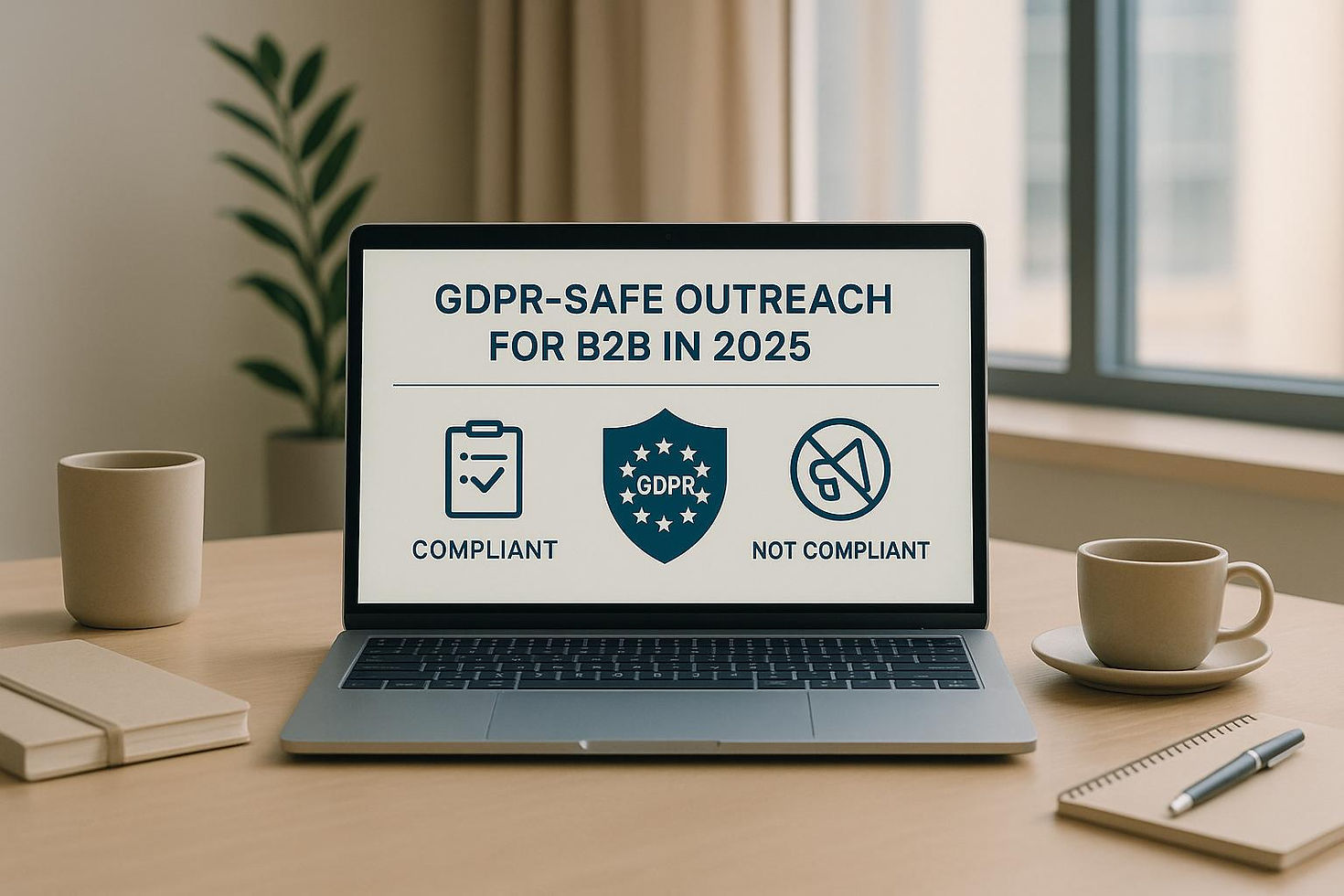
GDPR-Safe Outreach for B2B in 2025: What You Can and Cannot Do
- Henry McIntosh

- Sep 14, 2025
- 17 min read
GDPR compliance in B2B marketing is non-negotiable in 2025. Here's what you need to know:
- Personal vs Non-Personal Data: Business emails like are personal data under GDPR, while generic emails like are not.
- Legal Bases: Use legitimate interest for relevant professional outreach or obtain explicit consent for activities like newsletters or profiling.
- Allowed Methods: Emailing business addresses, LinkedIn messaging, and calling business landlines are compliant if done respectfully and with opt-out options.
- Prohibited Practices: Buying email lists, ignoring opt-outs, scraping data, or cold-calling personal numbers without consent are banned.
- Data Transparency: Always explain how you got someone’s information and provide clear privacy notices.
- Handling Requests: Respond to data access, correction, or deletion requests within one month, ensuring records are up-to-date.
Key takeaway: GDPR-compliant outreach protects your business from fines (up to £17.5 million) and builds trust with prospects. Stick to transparent, respectful communication while following legal guidelines.
B2B Marketing & GDPR part one: ‘Consent’ Vs ‘legitimate interests’
GDPR and UK Data Laws for B2B Marketing
When it comes to B2B marketing in the UK, the rules around GDPR are just as strict as they are for any other type of personal data processing. If your marketing efforts involve handling personal information about individuals, you’re required to follow the same principles of legal basis, transparency, and security. This means even when reaching out to marketing professionals, you must ensure compliance. The key lies in understanding the difference between personal and non-personal data, as this distinction shapes how you handle information in all B2B outreach activities.
Personal vs Non-Personal Data in B2B
To stay GDPR-compliant, it’s crucial to distinguish between personal and non-personal data. The line is drawn when business contact details reveal information about an identifiable individual.
Personal data in a B2B setting includes anything that can pinpoint a specific person within a business. For example, email addresses like jane.doe@company.com, job titles tied to a person, LinkedIn profiles, business cards, and behavioural data all fall under this category. Even indirect identifiers, such as “the person who attended our webinar from XYZ Company,” qualify as personal data under GDPR.
On the other hand, non-personal data refers to information about legal entities rather than individuals. Details about a company, such as "ABC Corp, Main Street, London", or generic contact points like info@company.com or sales@company.com, are not considered personal data and fall outside GDPR’s scope. Similarly, industry reports, market statistics, company financials, and organisational charts without individual names can be processed without triggering GDPR obligations.
Properly classifying data is the foundation of any GDPR-compliant B2B marketing strategy.
Data Processing in B2B Outreach
Once data is classified, it’s important to note that handling personal contact details in any form qualifies as data processing under GDPR. This means nearly all B2B marketing activities involving individual contact information fall under GDPR’s umbrella. Tools like CRM systems and social media platforms, such as LinkedIn, process personal data and must adhere to these rules.
Lead generation is a particularly tricky area. Whether you’re using web forms to collect business contact details, managing event registrations, or offering downloadable content that requires personal information, GDPR obligations kick in. Even passive activities, like website analytics that track individual behaviour, can count as personal data processing.
Different industries - such as technology, financial services, and professional services - face unique challenges when it comes to compliance. These include managing risks, onboarding clients, and handling data for business development or client relationship management.
Data processing doesn’t stop at the first interaction. It often extends to maintaining long-term relationships, whether that’s through scheduling meetings, tracking communication preferences, or keeping records of past interactions. Any system that stores or manages details about individual business contacts must meet GDPR requirements.
Legal Bases for GDPR-Compliant B2B Outreach
Under GDPR, processing personal data without a valid legal basis is prohibited. For B2B outreach, there are six potential legal grounds, but legitimate interest and consent are the most commonly applied. Knowing when and how to use each is crucial to ensure your outreach activities remain lawful.
Getting this wrong can be costly, with fines reaching up to 4% of annual turnover or £17.5 million.
Legitimate Interest in B2B Marketing
Legitimate interest provides a flexible option for B2B outreach, but it requires a clear and justifiable business need that doesn’t infringe on individual privacy.
In B2B scenarios, legitimate interest might include reaching out to relevant prospects, following up on prior business interactions, or contacting decision-makers within your target market. For example, if you’re a SaaS provider looking to connect with IT directors at mid-sized companies, you could argue a legitimate interest in informing them about your solutions.
To rely on this basis, you must complete a Legitimate Interest Assessment (LIA) before launching your campaign. This involves documenting:
- Your legitimate interest
- Why processing personal data is necessary to achieve this interest
- Evidence that your interest doesn’t override the individual’s privacy rights
Your LIA should take into account the nature of your relationship with the prospect, how you obtained their details, your intended use of their data, and any potential impact on their privacy. For instance, if a prospect has engaged with your content or attended one of your events, this strengthens your case for legitimate interest.
Make sure to keep detailed records of your LIA, including your reasoning and steps taken to minimise privacy risks. These records are invaluable if you face regulatory scrutiny or complaints.
However, legitimate interest has its limits. It doesn’t cover intrusive practices like cold calling mobile numbers or bombarding uninterested prospects with repeated messages. If your outreach methods are too invasive, legitimate interest may no longer apply, and explicit consent would be required.
When and How to Obtain Consent
Consent becomes necessary when legitimate interest doesn’t apply or when your data use goes beyond basic business communication. This includes activities like adding prospects to newsletters, sharing their data with third parties, or using it for profiling and automated decisions.
To comply with GDPR, consent must be freely given, specific, informed, and unambiguous. This means no pre-ticked boxes, no bundling of consent with other terms, and no making consent a condition for accessing basic services.
When requesting consent, be clear and specific. For example, instead of vague statements like “we may contact you about our services,” say: “We’ll send you monthly updates about our project management software and invite you to relevant webinars.”
Keep detailed records of consent, including the exact wording used, the date and time it was given, and the method of collection. Always include clear opt-out options in every communication. Many businesses use a double opt-in process for email marketing to ensure a reliable audit trail.
Managing consent doesn’t end with collection. People can withdraw consent at any time, and you must make this as easy as giving it. Include unsubscribe links in all communications and promptly process any withdrawal requests.
If you want to use data for new purposes or if your original consent request was unclear, you may need to seek fresh consent with updated, specific language.
Transparency and Contact Information
Selecting a legal basis is just one part of GDPR compliance. Clear communication about how you handle personal data is equally important. Every outreach effort should include transparent information about your data practices, either through a privacy notice or directly in your message.
Privacy notices should be easy to access and written in plain English. They need to explain your legal basis for processing, what data you collect, how it’s used, how long it’s retained, and the rights of the individual. For B2B outreach, this information is often shared via email signature links or on contact forms.
In cold outreach, include a brief explanation of your data practices directly in your message. For example: “We’re contacting you based on our legitimate interest in discussing solutions relevant to your role. You can opt out at any time by replying ‘STOP’ or view our privacy policy at [link].”
Respecting opt-out requests is not only a legal requirement but also good practice. When someone asks to opt out, act promptly and ensure they don’t receive further marketing messages. However, you may still contact them regarding ongoing business relationships or contractual matters.
To prevent accidental re-contact, maintain suppression lists of individuals who have opted out. These lists should be checked against all new data sources and shared across your organisation to ensure compliance.
Under GDPR, individuals have additional rights, such as requesting access to their data, correcting inaccuracies, or asking for deletion in certain circumstances. Having clear procedures to handle these requests shows your commitment to data protection and helps build trust.
Finally, be upfront about how you obtained someone’s data. If their contact details came from a third party, like an event organiser or industry directory, mention this in your initial outreach. This transparency fosters trust and demonstrates good faith in your data practices.
These principles form the foundation for GDPR-compliant B2B outreach strategies discussed throughout this article.
Allowed and Banned Outreach Methods in 2025
Knowing which outreach methods align with GDPR is crucial for running campaigns that avoid hefty fines and maintain trust. Whether a method is permitted or not often depends on the legal basis, the type of data you’re using, and how well you respect individuals' rights.
Allowed Outreach Methods
Here’s a breakdown of outreach practices that comply with GDPR when handled properly:
Business email outreach remains a reliable method if you follow the rules. You can contact business email addresses under the principle of legitimate interest, as long as the content is relevant to the recipient's professional role. For instance, emailing a CTO about cybersecurity tools or reaching out to a finance director regarding accounting software is generally acceptable.
Make sure your emails are clear and relevant. The subject line should match the content, and you must clearly identify yourself and your organisation. Always include an easy way for recipients to opt out of future emails.
LinkedIn messaging is another compliant option when targeting business profiles. Since LinkedIn users agree to receive professional communications by joining the platform, this provides an added layer of consent. Just ensure your messages are aligned with LinkedIn’s terms of service.
Cold calling business landlines is permitted under legitimate interest. However, cold calling mobile numbers requires explicit consent. Keep records of call outcomes and respect opt-out requests immediately - if someone says "no", you must stop contacting them.
Event-based outreach is usually fine if attendees willingly share their details for business purposes, such as at trade shows, webinars, or conferences. Just double-check the event’s privacy policy and ensure the consent terms allow follow-up communications.
Referral-based outreach is effective when handled transparently. If a mutual connection recommends someone, mention the referrer in your message and explain how you got their details. This openness strengthens your case under legitimate interest and builds credibility.
Content-driven outreach works well when someone has engaged with your website, downloaded resources, or attended your webinars. Following up with relevant information in these cases is reasonable and often expected.
These methods, when executed properly, help you stay compliant while maintaining effective communication.
Banned or Restricted Activities
Certain outreach practices are strictly off-limits or heavily restricted under GDPR:
Unsolicited marketing without a legal basis is a major violation. For example, you cannot purchase email lists and start sending promotional messages without obtaining proper consent or establishing legitimate interest. This includes using contact databases from third-party providers without verified consent chains.
Ignoring opt-out requests is another serious breach. If someone asks to stop receiving communications, you have a maximum of 30 days to process their request - though acting within 24 hours is best practice. Continuing to contact opted-out individuals can lead to complaints and regulatory action.
Using personal email addresses for business purposes without explicit consent is problematic. Personal domains like Gmail or Yahoo are typically intended for private use, making it harder to justify legitimate interest. Stick to business email addresses instead.
Automated data scraping is a direct violation of GDPR and often breaches platform-specific rules too. Avoid scraping contact details from websites or social media.
Sharing data with third parties without explicit consent is prohibited. Even if you think sharing data with partners or suppliers might benefit the individual, you cannot do so without their permission.
Profiling and automated decision-making without clear consent is also risky. If you’re using AI tools to score prospects or make automated decisions, you need explicit consent and must explain the logic behind these processes.
The consequences for non-compliance are severe. The Information Commissioner’s Office (ICO) can issue fines up to £17.5 million or 4% of your global annual turnover, whichever is higher. Beyond the financial hit, these breaches can harm your reputation and erode trust with customers.
Outreach Methods Comparison Table
Method | GDPR Status | Legal Basis | Requirements | Industry Example |
Business email to company domains | Allowed | Legitimate Interest | Relevant content, clear opt-out | SaaS provider contacting IT directors about security solutions |
LinkedIn messaging via platform | Allowed | Legitimate Interest + Platform consent | Professional relevance | Financial services firm reaching wealth managers about compliance tools |
Cold calling business landlines | Allowed | Legitimate Interest | Business hours, record keeping | Technology vendor calling procurement managers about software upgrades |
Personal email marketing | Restricted | Consent required | Explicit opt-in, clear purpose | Newsletter subscriptions with double opt-in confirmation |
Cold calling mobile numbers | Restricted | Consent required | Explicit permission | Follow-up calls after explicit phone consent at trade shows |
Purchased email lists | Banned | No valid basis | Cannot establish legitimate interest | Mass marketing to purchased contact databases |
Ignoring opt-out requests | Banned | Violates individual rights | Must process within 30 days | Continuing email campaigns after unsubscribe requests |
Data scraping from websites | Banned | No legal basis | Violates platform terms and data protection laws | Automated extraction of contact details from company websites |
Steps and Tools for GDPR Compliance
Ensuring GDPR compliance isn't just about avoiding fines - it’s a way to build trust with your audience, especially as data privacy becomes more important to individuals. It requires consistent effort and reliable systems to stay on track.
Data Audits and Policy Updates
Start by mapping out all the personal data your business handles. This includes data flowing through your CRM, email platforms, social media tools, and any third-party services you use. Create a detailed inventory that outlines each data source, the legal basis for processing it, and when it was collected. This documentation is critical if the ICO ever reviews your data handling.
Set clear retention periods for every dataset. While GDPR doesn’t dictate exact timelines, you need to justify how long you keep personal data and ensure it aligns with your stated policies.
Your privacy policy is another key piece of the puzzle. Update it to reflect your current practices, explaining what data you collect, why you need it, how long you retain it, and who you share it with. Make sure it’s easily accessible on your website and includes details specific to your B2B marketing activities.
To stay compliant, conduct quarterly reviews of your data processing activities. This allows you to check that your teams are following procedures, update records where necessary, and ensure any new tools or campaigns meet GDPR standards. Regular reviews help you spot and fix compliance issues early.
Finally, ensure your outreach respects the rights of individuals, particularly their ability to withdraw consent at any time.
Setting Up Opt-Out Systems
Having a robust opt-out system is just as important as conducting data audits. GDPR requires that opting out is as simple as opting in. Your systems should handle unsubscribe requests quickly and across all communication channels.
Set up a universal unsubscribe mechanism to ensure that when someone opts out, they’re removed from all communication lists - not just the one they unsubscribed from. Automate this process to act within 24 hours. For example, configure your email marketing platform to suppress unsubscribed contacts automatically and sync this information with your CRM and calling tools.
Each communication channel should have clear opt-out instructions. Email unsubscribe links should be easy to find and functional. For phone calls, train your team to record opt-out requests immediately and confirm the contact’s details. Even LinkedIn messages should include instructions on how to stop further communication.
Keep a record of every opt-out request, including timestamps and processing details, to demonstrate compliance if questioned. Analysing these records can also help identify trends in opt-out rates, which may signal issues with your messaging.
Regularly test your opt-out systems. Use test contacts to confirm that unsubscribe links work as intended and that suppression lists are functioning across all platforms. Many compliance failures occur because technical systems aren’t properly integrated.
Compliance Tools for B2B Marketers
Once your data audits and opt-out systems are in place, the next step is to use tools that help maintain GDPR compliance as part of your daily operations. Look for platforms that embed privacy protections into their design rather than treating them as an add-on.
Choose CRM and email platforms with built-in consent management and automated suppression features. Tools like HubSpot and Salesforce can track legal bases for data processing, manage opt-out requests, and enforce data retention policies automatically. These features ensure that no record slips through the cracks.
As your database grows, consent management platforms like OneTrust or Cookiebot can simplify the process. They’re particularly useful for managing consent across multiple channels or when sharing data with partners. These tools keep detailed records of what each individual has consented to and when.
To safeguard personal data, use encryption, secure file-sharing tools, and access control systems. This not only helps protect sensitive information but also reduces the risk of ICO investigations and reputational harm.
For phone-based outreach, integrate call recording and CRM tools. These systems can automatically log call outcomes, record opt-out requests, and sync them with your CRM, ensuring compliance with GDPR during telephone marketing.
If you’re planning complex campaigns or using AI for lead scoring, consider privacy impact assessment tools. These can help you identify potential compliance risks before launching campaigns, saving time and reducing the chance of errors.
Finally, prioritise tools that integrate well with your existing marketing stack. Seamless integration reduces the risk of data gaps and ensures you have a clear audit trail for all data processing activities.
Handling Data Subject Requests in B2B Outreach
Building on the importance of compliant outreach, managing data subject requests is a key part of maintaining trust and staying on the right side of the law. When individuals exercise their GDPR rights, how you respond can either strengthen or damage their confidence in your business. Your approach to these requests reflects your commitment to respecting data privacy and can shape future relationships.
Individual Rights Under GDPR
GDPR gives individuals several rights, even in the context of B2B marketing. Understanding these rights is crucial to setting up effective response processes and avoiding compliance pitfalls.
- The right of access: Individuals can request access to their personal data (like contact details, job titles, or interaction history) and the legal basis for its processing. This information must be provided within one month.
- The right to rectification: If someone’s data is inaccurate or incomplete, they can request corrections. You’re also required to notify any third parties who received the incorrect data.
- The right to erasure: Also known as the "right to be forgotten", this allows individuals to request data deletion in specific situations, such as when the data is no longer needed, consent has been withdrawn, or they object to its use based on legitimate interests.
- The right to restrict processing: This allows individuals to limit how their data is used without requiring its deletion. For instance, they might ask you to pause marketing activities while investigating a data accuracy issue. During this time, the data can be stored but not actively processed.
- The right to data portability: When requested, you must provide personal data in a structured, machine-readable format, such as a CSV or JSON file. This applies to data processed based on consent or contract performance.
- The right to object: This is particularly relevant for B2B marketing. If someone objects to processing based on legitimate interests, including direct marketing, you must stop using their data for these purposes unless you can prove overriding legitimate grounds.
- Rights related to automated decision-making: Individuals are protected against decisions made solely through automated processes, including profiling. If you use AI for lead scoring or automated email campaigns that significantly impact individuals, they have the right to human intervention and an explanation.
With these rights in mind, the next step is to create efficient systems for managing such requests.
Managing Data Requests Efficiently
Handling these requests effectively requires a well-organised and transparent process. The clock starts ticking on the one-month response timeframe as soon as you receive the request, so preparation is essential.
- Set up a dedicated contact point for data requests, such as a specific email address (e.g., dataprotection@yourcompany.com). Ensure your team knows how to identify and escalate these requests, as they can come through various channels - email, phone, social media, or even during sales calls.
- Verify the requester’s identity before sharing any data. For B2B contacts, this might involve confirming their work email address or asking for additional identification if the request comes from a personal account.
- Keep detailed records of each request and your response, including timestamps. This creates an audit trail and ensures compliance. You can use a simple spreadsheet or a privacy management tool to track these interactions.
- Search all relevant systems - your CRM, email platforms, call recordings, marketing tools, and local storage - to ensure no data is overlooked.
- Use clear and straightforward language in your responses. If you need to refuse a request, explain the legal reason and inform the individual of their right to complain to the ICO.
- Stay on top of deadlines. While complex requests may allow for a two-month extension, you must notify the individual within the first month and explain why more time is needed.
- Train your team regularly. Everyone, from sales reps to customer service and marketing staff, should know how to identify and handle data requests properly. Training ensures consistency and reduces the risk of missed or mishandled requests.
When someone objects to marketing, act quickly to honour their request across all channels. Update your CRM, email suppression lists, and calling systems at the same time. For example, if someone opts out of email marketing but still receives LinkedIn messages, they may escalate their complaint to the ICO.
Finally, monitor patterns in data requests to spot potential issues. A high number of rectification requests for job titles might indicate flawed data sources, while frequent erasure requests could reveal problems with consent processes or unclear communication. Handling these requests well not only upholds GDPR standards but also reinforces trust in your business practices.
Conclusion: Building Trust Through GDPR-Safe Outreach
The strategies outlined earlier offer more than just compliance - they lay the groundwork for strong, enduring B2B partnerships. Prioritising GDPR compliance isn't just about ticking boxes; it's about demonstrating respect for privacy and a commitment to ethical business practices. This thoughtful approach not only meets legal obligations but also gives you an edge in a market that values trust and integrity.
Trust starts with adhering to the law. Businesses that weave compliance into their growth strategies stand out in today's privacy-focused world. Transparent and lawful outreach doesn't just meet regulations - it attracts better-quality leads and fosters genuine engagement. By correctly applying legitimate interest, offering clear opt-out options, and swiftly handling data requests, you're sending a message of professionalism and care. This gives your sales team the confidence to connect with prospects, knowing every interaction is both compliant and ethical.
Respecting data protection laws also builds a reputation that money can't buy. This is especially critical when dealing with senior decision-makers in fields like finance, technology, and professional services, where data security is non-negotiable.
As privacy regulations tighten in the years ahead, businesses with strong compliance frameworks will find themselves better prepared to adapt. Meanwhile, those taking shortcuts will likely face mounting costs and challenges. By committing to lawful and transparent outreach now, you're not just protecting your business - you’re cultivating the trust and operational excellence that will fuel your success well into 2025 and beyond.
FAQs
How can I ensure my B2B outreach on LinkedIn complies with GDPR regulations in 2025?
To ensure your LinkedIn outreach aligns with GDPR requirements in 2025, you must always obtain before reaching out to individuals. This can be done using opt-in forms or by providing clear and transparent information about how their data will be used. Keep a record of these permissions and establish a straightforward data retention policy.
It's equally important to honour individuals' rights to access, correct, or delete their data. Only collect the information that’s absolutely necessary for your outreach efforts. Using tools specifically designed for GDPR compliance can make managing this process much easier. Above all, focus on transparency in your data practices - not only to meet legal obligations but also to foster trust with your audience.
How can my company efficiently handle data subject requests while staying GDPR-compliant?
To stay on top of data subject requests and maintain GDPR compliance in 2025, your company needs well-defined procedures for managing these requests within the mandated one-month period. This means verifying the requester’s identity, identifying all relevant personal data, and delivering responses that are clear and straightforward.
Maintaining comprehensive records of your data processing activities is crucial. Using dependable data protection tools can make the process smoother, and automating parts of the workflow can help you respond quickly. This not only safeguards individuals' rights but also reduces the chances of falling short on compliance.
What’s the difference between legitimate interest and explicit consent in B2B marketing under GDPR?
Under GDPR, explicit consent requires individuals to actively and clearly agree to the use of their personal data for specific reasons. This kind of consent is typically necessary when dealing with sensitive data or in situations where regulations demand it.
On the other hand, legitimate interest allows businesses to process personal data if they have a valid and justifiable reason, provided this doesn’t infringe on the individual’s rights. To use this basis, businesses must perform a balancing test to ensure the data processing is both fair and necessary.
In the context of B2B marketing, legitimate interest is often relied upon for reaching out to corporate professionals. However, explicit consent is generally required when handling personal data or engaging in activities that carry greater risks.


Comments